
Dried anchovy protein: avoiding serving-size mistakes
Pinned 2026-10-25
Posted 2026-10-25
Posted after the board's automated content and source checks passed on 2026-10-25 · Health notice
In short
How to match dried anchovy to its food-table entry, weigh the edible portion and distinguish whole fish from strained stock or a cooked rice dish.
Sheet 01 of 09
Match the fish before calculating the portion
- Dried anchovy protein calculations depend on the exact preparation and the weight of the edible portion. Japan’s Standard Tables of Food Composition identify dried Japanese anchovy (niboshi) as fish that has been boiled and dried whole. That description establishes which food the entry covers.
- The entry comes from Japan’s Ministry of Education, Culture, Sports, Science and Technology, known as MEXT. Its scientific name is Engraulis japonicus. When choosing a food-table entry, read the species and preparation together rather than stopping at the word anchovy. The preparation is part of the food’s identity in the table.
- A reference weight is the basis for reporting a composition value. The amount of fish on a plate is a separate measurement. USDA FoodData Central’s Foundation Foods documentation explains how an edible portion’s weight is used to convert a reference value into an amount for that portion. Keep those quantities separately labeled while working through a calculation.
- For a small weighed portion, begin by describing the fish as it will be eaten. Record whether it is the whole boiled-and-dried preparation, prepared fish with parts removed, or fish incorporated into cooking. This connects the food-table description to the kitchen task before any arithmetic begins. The later sections follow those different uses through to the portion being described.
Sheet 02 of 09
Dried anchovy names can describe different preparations
- MEXT gives dried young Japanese anchovy, called tazukuri, a separate entry from the whole boiled-and-dried fish. The shared species name does not make those preparations the same table entry. Read the processing description alongside the common name when deciding which entry matches the food.
- Japan’s Ministry of Agriculture, Forestry and Fisheries, known as MAFF, separates several ways of preparing dried fish. Salted-and-dried fish are salted before drying. Seasoned-and-dried fish are seasoned or marinated before drying. The ministry also distinguishes drying alone from preparations involving boiling or grilling before drying.
- Those distinctions give a practical way to read a food description. Look for a preparation word such as boiled, salted or seasoned, then carry that word into the name used in a nutrition calculation. Do not shorten every preparation to dried anchovy and assume that the same composition entry applies. A precise description keeps a preparation difference visible instead of hiding it behind a familiar food name.
- Names used in cooking can be broader than the species named in a database. The source on Japanese dried-fish dishes explains that the boiled-and-dried fish category is also called iriko and can include small fish other than Japanese anchovy. Use that local name as a clue to the preparation, then check the species separately. A culinary name and a scientific identification answer different parts of the matching task.
Sheet 03 of 09
Keep the protein field attached to its value
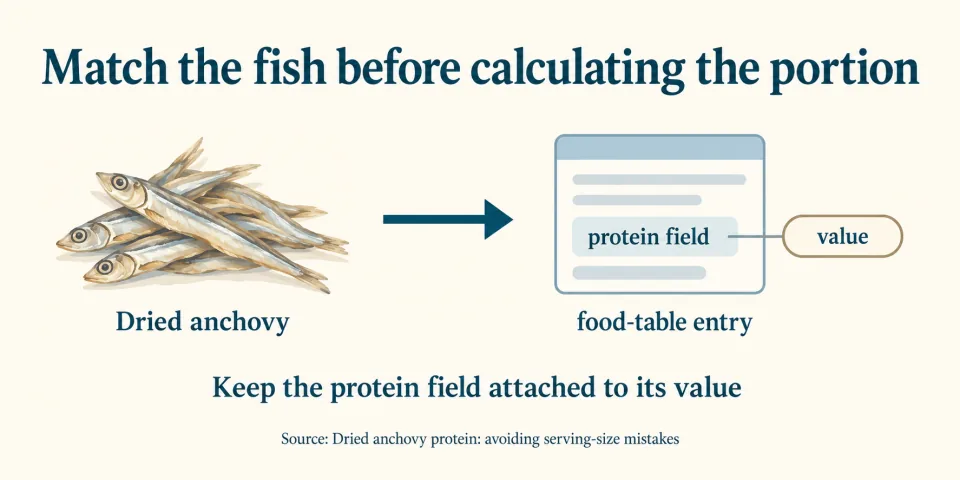
- The MEXT dried-anchovy table has separate fields for protein and protein calculated from amino acid composition. These are separately labeled entries within the same food record. Preserve the full field name when taking information from the table.
- A useful reading sequence is to find the food description, locate the protein field and then read the reporting basis. Keep those details together in any written calculation. Copying a value without its heading removes the information needed to tell which protein field it came from. The food name alone does not preserve that distinction.
- This also matters when checking a comparison assembled from different records. Read the heading attached to each value before comparing the amounts. If a calculation begins with the field labeled protein, keep that field identified throughout the calculation. Do not silently substitute the amino-acid-based field partway through.
- For a clear explanation, distinguish the database field from the portion calculation in the wording. The field tells the reader which measure the table reports; the portion calculation applies that measure to a specified weight of food. Keeping those jobs separate makes the reasoning easier to follow. It also lets a reader trace the portion statement back to the exact field, rather than merely to a page containing several composition measures.
Sheet 04 of 09
Weigh the edible fish used in the calculation
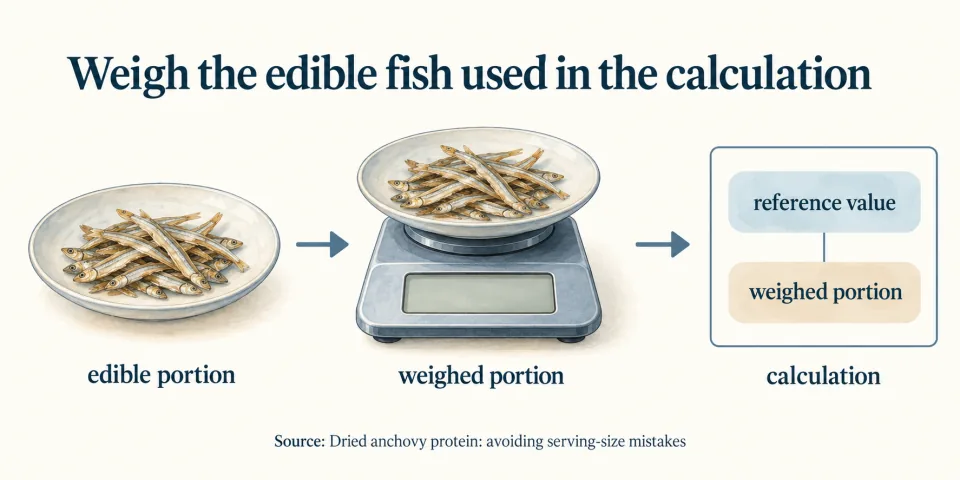
- USDA FoodData Central’s Foundation Foods documentation defines portion weights as edible material, with refuse excluded. For a dried-anchovy calculation, identify what will be included in the edible portion before recording its weight. Keep the description of that material beside the measurement.
- MAFF explains that dried fish may be processed intact or after removal of the guts and gills. Its dried-fish rice recipe also describes removing parts before the flesh goes into the dish. Those examples show why the preparation needs to be recorded alongside the weight. A whole-fish entry and a portion prepared with parts removed have different descriptions.
- If the kitchen task includes removing parts, keep the weight of the fish before preparation separate from the weight retained for the dish. Weigh the retained material as its own portion and describe what remains. This is a way to document the preparation, not a reason to assign the whole-fish entry unchanged to the remaining flesh. The original entry specifically describes whole fish.
- For fish that will be eaten whole, record the weighed portion under that whole-fish description. For fish being divided between flesh and stock, record those uses separately. Avoid describing the starting weight as though it were automatically the weight eaten in the finished dish. The edible-portion basis in USDA FoodData Central and the preparation steps in MAFF’s recipe address different stages of that task.
Sheet 05 of 09
Convert a reference value to a weighed portion
- USDA FoodData Central’s portion-conversion method scales a reference value by the weight of the edible portion. In words, multiply the nutrient value by the portion weight, then divide by the reference weight. Use matching weight units for the portion and the reference basis.
- Keep the calculation in a clear sequence. Identify the exact food and protein field, retain the reference weight attached to that field, and enter the measured edible weight. The result belongs to that measured portion. Write the final description so that the protein amount remains attached to the amount and preparation of food it describes.
- The arithmetic does not correct a mismatch between the food being weighed and the food-table entry. A calculation using the wrong preparation still starts from the wrong food description. Check that match before converting the value, especially when the kitchen preparation removes parts or turns the fish into stock. Food identification and portion conversion are separate checks.
- USDA FoodData Central also explains that portion weights belong to specific data types. Food-specific portion information appears in the measure tab or the downloadable food portion file. When using a listed household measure, keep it with the food record and data type it accompanies. Do not transfer a portion weight between records simply because their common names resemble each other. A directly weighed portion provides the weight for the material being described, while the composition entry still needs to match that material.
Sheet 06 of 09
Read the serving basis on a label
- A label serving and the contents of a package are different reporting bases. The U.S. FDA explains that Nutrition Facts labels show a serving size using a household measure followed by its metric weight. This describes the U.S. label format.
- When reading such a label, locate the serving-size statement before reading the protein line. Keep the household measure and its gram weight together in your notes. Then check whether the displayed nutrient information is for the labeled serving or for the package. The heading establishes what amount of food the nutrition information describes.
- Some U.S. Nutrition Facts labels display separate columns for a serving and the entire package. Read the column heading together with the protein entry below it. Do not attach an amount from the package column to the serving weight. That would combine information reported on different bases.
- The FDA explains that serving sizes reflect customary consumption rather than advice about how much to eat. A serving statement can therefore help interpret a label without becoming a personal food target. For a portion weighed separately, keep its actual weight distinct from the serving weight printed on the label.
- The package statement, label serving and weighed portion each have a role. Use the package statement to identify package-level information, the serving statement to interpret the relevant nutrition column, and the measured weight to describe the portion in question. Apply this reading process specifically to the U.S. format described by the FDA.
Sheet 07 of 09
Strained stock is separate from the dried fish
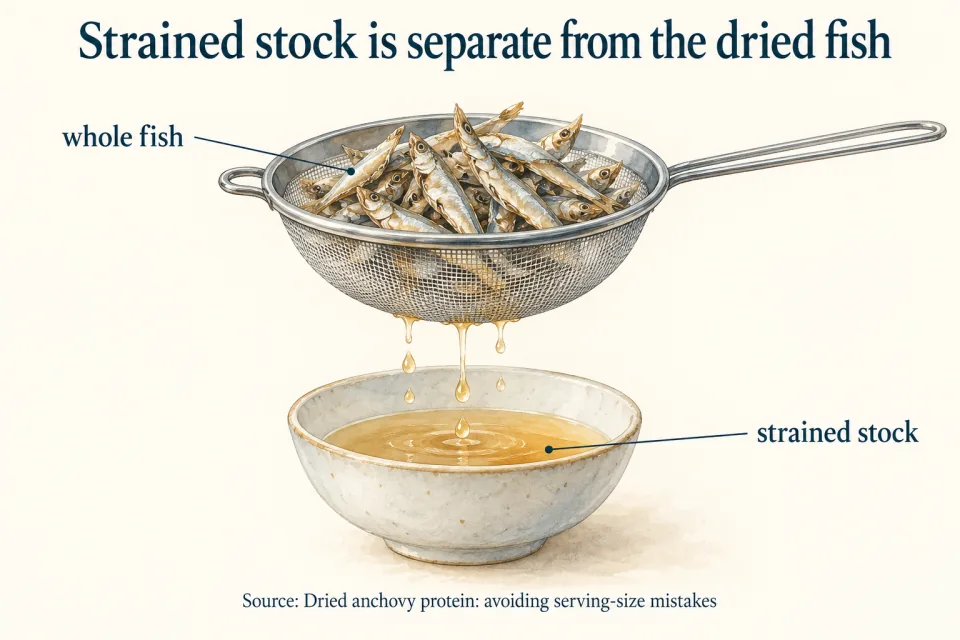
- MEXT classifies dried-anchovy stock as soup stock in an entry separate from the dried fish. The liquid and the fish used to prepare it therefore have distinct food records. Choose the entry that describes the food being discussed at the end of cooking.
- Koga City in Japan describes preparing the stock by soaking or heating the dried fish in water. Its methods finish by letting the fish settle and filtering the stock through a cloth. That filtering step separates the liquid being kept from the fish solids. Record it when describing the finished preparation.
- The starting fish weight does not establish the protein amount in the filtered stock. The whole-fish entry describes the fish, while the stock entry describes the liquid preparation. Do not carry a whole-fish portion calculation directly into a statement about a bowl of strained broth. The food being described has changed during the recipe.
- Koga City also explains that crushing the fish into smaller pieces helps release their flavor. Keep that culinary observation within its stated scope. It describes flavor extraction during stock preparation, not a measured protein amount in the liquid. A recipe instruction and a food-composition measurement provide different information.
- The city lists miso soup, simmered dishes and rice cooked with other ingredients as uses for the stock. In each case, name the stock as an ingredient of the next preparation. This records what entered the dish without treating the original dry fish, the filtered liquid and the finished meal as interchangeable foods.
Sheet 08 of 09
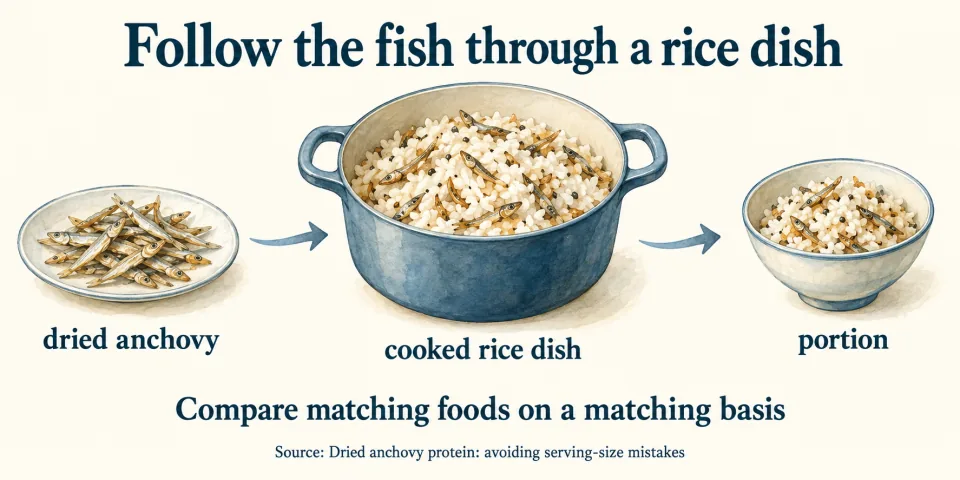
Follow the fish through a rice dish
- MAFF’s dried-anchovy rice recipe uses fish flesh in the rice and stock made from removed heads. It provides a concrete example of a preparation in which different parts of the fish follow different paths. The starting fish description alone does not describe the finished dish.
- The recipe removes the heads and abdominal material before the flesh is cut up. The removed heads are soaked in water to make stock. Follow those steps separately when documenting the recipe: identify the flesh that goes into the rice and the stock prepared for cooking. Keep the removed material distinct from the retained flesh.
- The flesh is then combined with chopped vegetables, rice, stock and seasoning in a pot. At this stage, describe the food as a mixed rice dish. The dried-anchovy entry does not describe the composition of that finished mixture. Its identity covers the fish preparation, whereas the recipe combines several ingredients.
- MAFF notes that the vegetables can vary with preferences and seasonal availability, with burdock and different mushrooms among the options. Record the ingredients actually used when describing a particular version. A recipe name can identify the dish while its ingredient record explains the version being considered.
- For a serving-size explanation, keep the ingredient stage separate from the finished-dish stage. Describe the fish flesh as an ingredient and the cooked rice mixture as the food being portioned. The worked example is the sequence itself: removed parts contribute to stock, retained flesh enters the pot, and the rice is served as a mixed dish. That sequence explains why a dried-fish portion and a portion of the rice dish need different descriptions.
Sheet 09 of 09
Compare matching foods on a matching basis
- A dried-anchovy comparison needs the food preparation, protein field and weight basis to remain visible. Begin with the descriptions attached to the records being compared. MEXT separates whole boiled-and-dried anchovy, dried young anchovy and anchovy stock, so retain those preparation names in the comparison.
- Then inspect the weight basis. If the question concerns composition at a reference weight, keep the reference basis consistent. If the question concerns particular portions, use the edible weight of each portion and label it clearly. Do not describe differently sized portions as though they were an equal-weight comparison. USDA FoodData Central’s conversion method makes portion weight part of the calculation.
- A comparison can also answer a question about food identity before it addresses amounts. The MEXT entries establish that the dried whole fish and its stock are recorded separately. MAFF’s rice recipe establishes that the cooked dish combines flesh, stock and other ingredients. These descriptions help decide which foods belong in the proposed comparison.
- For the final wording, attach each amount to its food, preparation and reporting basis. Keep a label serving identified as a label serving, and keep a weighed portion identified by the material weighed. This makes the statement readable without requiring someone to reconstruct the calculation from a food name alone. The comparison then answers a defined question about the foods and portions it describes.
Sources for this notice
Japanese anchovy, Niboshi (boiled and dried whole), food number 10045Japanese anchovy, Tazukuri (dried young anchovy), food number 10046Niboshi dashi (stock of small dried sardine), food number 17023Dried foods | Traditional Foods in JapanFoundation Foods DocumentationServing Size on the Nutrition Facts LabelSea Bass Fish Head Broth Treated by Thermo-Ultrasonication: Improving the Nutritional Properties and Emulsion StabilityIriko gohan (rice with dried sardines) | Our Regional CuisinesJapan’s Dried Fish Dishes: Whet Your Appetite with a Wide Variety of Himono
Desk file
On file for this notice
- Credited to
- Health Protein
- Backed by
- 9 sources listed above
Short notices on the protein in everyday foods from around the world, from dal, paneer and lentils to eggs, fish, yogurt and quinoa. One food per notice, every number sourced.
About this board · How notices are checked · Health notice · People on this board · Expert panel · Privacy notice · Contact the board · Grievances desk