
Yogurt protein estimates: spoon measurements and weighed portions
Pinned 2026-11-05
Posted 2026-11-05
Posted after the board's automated content and source checks passed on 2026-11-05 · Health notice
In short
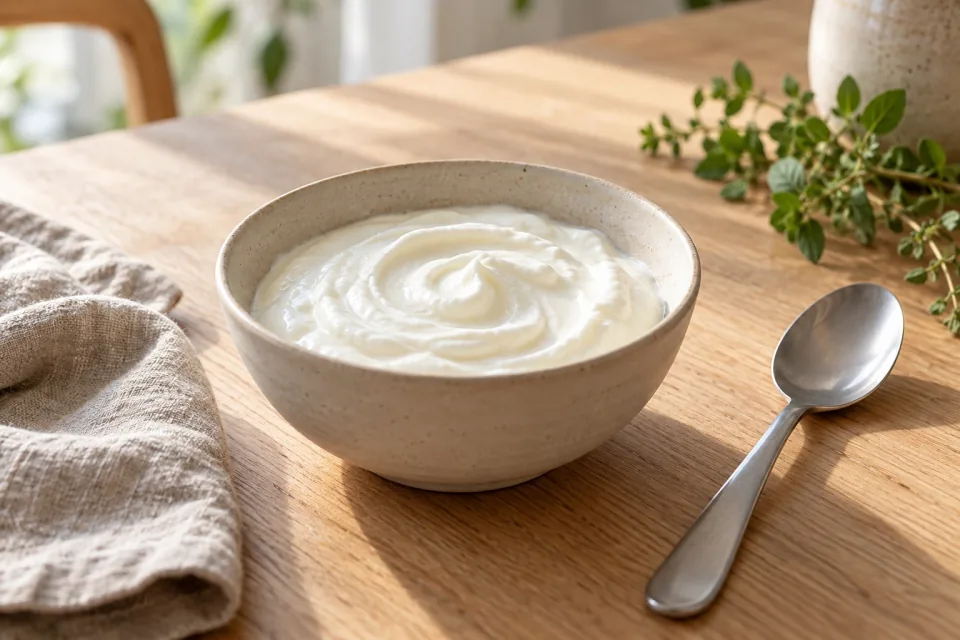
How to measure Greek yogurt for a protein estimate, account for level and heaped spoonfuls, and weigh the yogurt that reaches the bowl.
Sheet 01 of 09
Weigh the yogurt used in the protein calculation
- A protein estimate for Greek yogurt starts with the weight of the yogurt and a matching nutrient value. Counting spoonfuls adds another measurement step: establishing how much yogurt those spoonfuls contain. A spoon can transfer the yogurt while a scale measures the portion.
- The United States National Institute of Standards and Technology recommends weighing ingredients to improve accuracy compared with measuring by volume. Its method for converting a customary measure into grams is to fill the usual utensil and then weigh the ingredient. Applied to yogurt, this connects a familiar kitchen action with the weight needed for a nutrient calculation.
- Keep the food description, measurement and calculation together. Describe the yogurt being measured, record its weight separately from the bowl, and use the corresponding food entry when calculating protein. A note that says only “spoonfuls of yogurt” leaves the utensil and filling method unspecified.
- Decide what the measurement describes before filling the spoon. For a sauce, it may describe yogurt added to a mixing bowl. For a separate portion, it may describe yogurt placed in a serving dish. These are useful measurement boundaries because they identify where the yogurt must arrive before its weight is recorded.
Sheet 02 of 09
Use a measuring spoon when the recipe specifies volume
- An eating spoon does not establish a standard recipe measure. Mississippi State University Extension advises using measuring spoons because eating spoons differ in size and capacity. A spoon selected from a cutlery drawer therefore needs to be distinguished from a utensil marked as a tablespoon or teaspoon.
- Measuring spoons accommodate small amounts of wet or dry ingredients, according to University of Illinois Extension. Their role is to define the volume being measured. When using them for yogurt, record the marked measure and whether the contents were leveled. This describes the procedure more clearly than calling the portion a scoop.
- The distinction also applies to cups. University of Illinois Extension explains that a dry measuring cup holds its stated quantity when filled to the rim, while a liquid measuring cup has measurement lines and usually a handle and pouring spout. N.C. Cooperative Extension places yogurt among the semiliquid ingredients measured with dry measuring cups.
- Choose the utensil to match the measurement being made. If following a volume instruction, use the appropriate marked measure and filling method. If establishing a weight for a protein calculation, use the spoon or cup to move the yogurt into the weighed bowl. The utensil can remain useful without its capacity becoming the basis of the calculation.
- For larger recipe quantities, Mississippi State University Extension recommends choosing a measure that reduces the number of separate scoops, because repeated scoops can be miscounted.
Sheet 03 of 09
Keep tablespoon volume separate from yogurt weight
- A tablespoon conversion describes volume, while a weighed yogurt portion is recorded in grams. The United States National Institute of Standards and Technology gives an approximate kitchen equivalent of 15 mL for a tablespoon. That entry belongs to a table of volume equivalents; it does not assign a gram weight to the yogurt filling the spoon.
- Ingredient density matters when converting between volume and weight, according to the same institute's culinary measurement guidance. Use that distinction when reading recipe notes. A capacity printed on a spoon identifies the space available inside it. Weighing the yogurt transferred from that spoon supplies a different measurement for the portion calculation.
- The recipe's country can also affect the meaning of tablespoon. In an ABC interview, Australia's National Measurement Institute chief metrologist identifies an Australian tablespoon as 20 mL. The interview advises checking a recipe's country of origin when interpreting tablespoon quantities. For an international recipe, retain the stated volume in the measurement notes instead of relying on the utensil's name alone.
- More detailed conversion tables answer a narrower question about units. The United States National Institute of Standards and Technology lists approximately 14.79 mL for a U.S. customary tablespoon. This added precision still describes volume. To connect a spoon measure with a yogurt weight, follow the ingredient-specific procedure of filling the measure and weighing what it delivers.
Sheet 04 of 09
Level the measure before transferring the yogurt
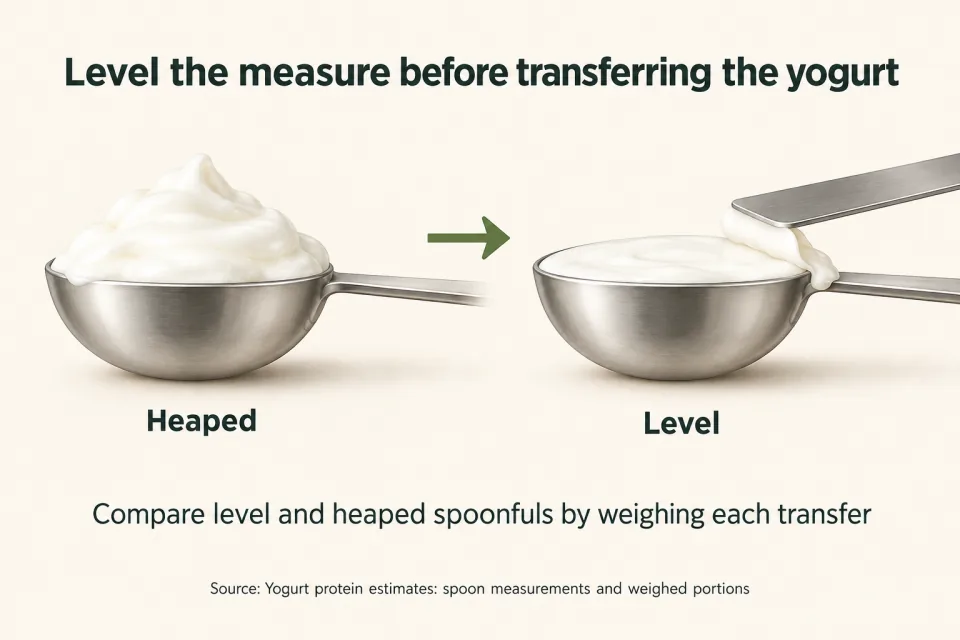
- A level spoonful ends at the rim; a heaped spoonful retains yogurt above it. The culinary definitions in the Tablespoon reference distinguish these filling methods and describe a heap as dependent on the utensil and ingredient. Use the filling description as part of the measurement record.
- N.C. Cooperative Extension recommends leveling semiliquid ingredients and tapping the measuring cup when needed to remove air bubbles. Its guidance describes using the flat side of a butter knife or spatula to level a measure. For a yogurt measurement, fill the utensil, attend to visible gaps and draw the flat edge across the rim before transferring the contents.
- Keep the excess removed during leveling separate from the measured portion. Return that excess to the original container, or set it aside while completing the measurement. Then transfer the leveled contents to the receiving bowl. This sequence gives “level” a clear meaning in the procedure: the yogurt remaining inside the measure after the top has been made even.
- A heaped spoon can also be weighed, but record it as heaped. Avoid using the appearance of the mound as the basis for a fixed conversion. The Tablespoon reference explains that a heaped measure has no precise volume because the heap depends on the spoon's shape and the ingredient's physical properties. Weighing that particular transfer gives the comparison a recorded quantity without requiring a standard heap.
Sheet 05 of 09
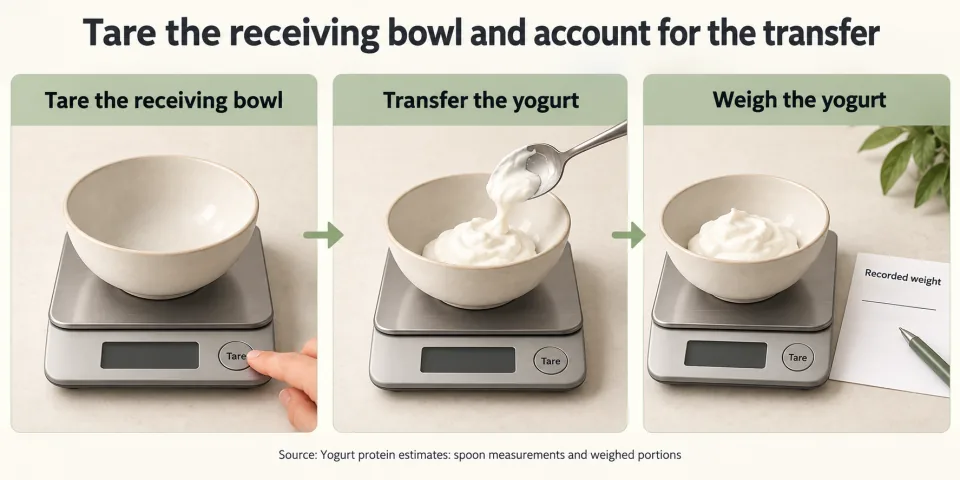
Tare the receiving bowl and account for the transfer
- Weighing yogurt in the receiving bowl records the amount transferred there. The United States National Institute of Standards and Technology explains that taring removes the bowl's weight from the scale display. Place the empty bowl on the scale, tare it, and then add the yogurt.
- For this method, put the yogurt directly into the bowl that will hold the portion or recipe ingredient. Leave the spoon outside the bowl when taking the reading. Record the displayed yogurt weight after the transfer is complete, keeping the utensil out of the measurement.
- Mississippi State University Extension recommends using a spoon or rubber spatula to remove thick liquids from a measuring cup. Apply that transfer step before recording the final weight if the intention is to include the contents of the filled measure. Scrape the yogurt into the receiving bowl, remove the utensil, and then read the scale.
- Yogurt still on the transfer utensil needs a clear place in the procedure. If it is scraped into the bowl, take the reading afterward. If it remains outside the bowl, describe the measurement as the yogurt delivered to the bowl. This avoids assigning a guessed residue amount or assuming that filling a measure completes the transfer.
- The receiving-bowl method also separates transfer from mixing. The United States National Institute of Standards and Technology advises removing the bowl from the scale and setting it on a stable surface before mixing. Record the ingredient weight, then move the bowl to continue preparation.
Sheet 06 of 09
Apply the portion formula to the recorded weight
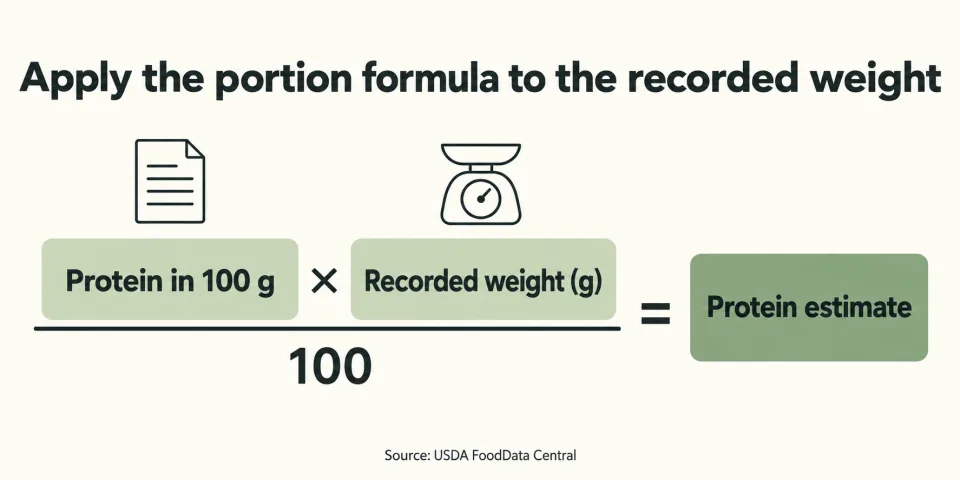
- Use the measured yogurt weight with the protein value for the corresponding food entry. USDA FoodData Central calculates a portion's nutrient amount by multiplying the nutrient value per 100 g by the portion weight in grams, then dividing by 100. The weight in that calculation is the food portion being described.
- Build the calculation record around the food description before entering the weight. Keep the food entry's name beside its protein value, and identify whether the kitchen measurement describes yogurt transferred to a serving bowl or yogurt added to a recipe. This gives the calculation an identifiable food and a defined portion.
- Next, enter the yogurt weight recorded after taring and completing the transfer. Keep the nutrient value and the portion weight in their separate places in the calculation. A tablespoon capacity belongs in the measurement notes if a spoon was used; the weighed portion belongs in the weight part of the formula.
- USDA FoodData Central explains that portion weights refer to edible material and that portion descriptions and weights are specific to each data type. Keep a household measure attached to the entry that supplies it. Avoid moving a portion description from a different entry into the calculation simply because the utensil has the same name.
- The final record can read as connected prose: identify the yogurt entry, describe the measured portion, and state the protein amount calculated for that portion with its source. Keep the calculation about the food measured. It does not need to become an instruction about how much a reader should eat.
Sheet 07 of 09
Compare level and heaped spoonfuls by weighing each transfer
- A practical comparison uses the same yogurt and spoon, with separate weights for the level and heaped transfers. This combines the institute's measure-then-weigh method with the culinary distinction between a leveled measure and a heap. It is a procedure for recording a comparison, without presuming its result.
- Start with the level measure. Fill the spoon, level it, and transfer its contents into a tared receiving bowl. Complete the scraping step chosen for the comparison, remove the utensil and record the weight. Describe the portion as a level spoonful transferred to the bowl.
- Prepare the heaped measure with the same spoon and yogurt. Use an empty tared bowl, or tare the receiving bowl again before the next addition. Transfer the heap using the same scraping procedure and record the added weight. Keep the filling descriptions beside the respective readings so the weights remain tied to what was done.
- For a protein comparison, apply the same corresponding nutrient value to each measured portion. Change the portion weight in the calculation while keeping the yogurt entry unchanged. This makes the comparison about the measured amounts of that yogurt, rather than about different foods or nutrient entries.
- Preserve the scope of the result in any recipe note. Describe the utensil, yogurt, filling method and transfer procedure used. A separately weighed heap gives information about that transfer; the reference definition does not give heaps a universal capacity. Repeating the procedure with another yogurt should therefore begin with a fresh measurement record.
Sheet 08 of 09
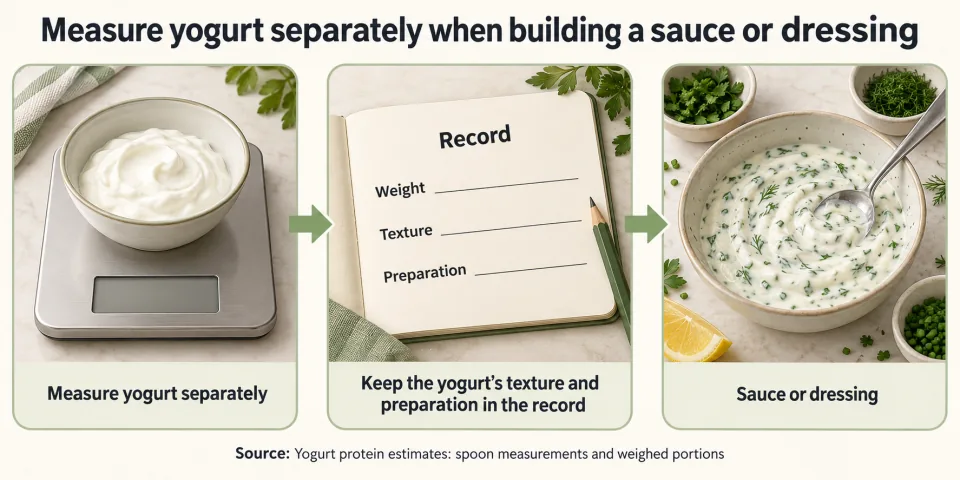
Measure yogurt separately when building a sauce or dressing
- Record the yogurt addition before mixing it with other ingredients. Harvard's Nutrition Source describes plain yogurt as an ingredient in sauces and dressings. In that setting, the measurement question is how much yogurt enters the recipe, so the receiving bowl is also the mixing bowl.
- The United States National Institute of Standards and Technology explains that taring after an addition allows the next ingredient to be weighed separately in the same bowl. If the bowl already holds another ingredient, tare before adding the yogurt. Transfer and scrape the yogurt, then record its weight before resetting the display for a later addition.
- Keep an ingredient record as preparation continues. Write the yogurt weight beside the yogurt description, then record later additions separately. This preserves the yogurt measurement after other ingredients have entered the bowl and after the contents have been mixed.
- Use the corresponding yogurt entry when calculating the protein contributed by that addition. Keep that result labeled as the yogurt's contribution to the recipe. A calculation built from the yogurt measurement describes that ingredient; a record for the whole recipe needs the other ingredients to remain separately identified.
- The same distinction helps when using a measured cup to carry yogurt to the bowl. Level the cup as appropriate, complete the transfer, and take the yogurt reading before moving on. Finish recording the separate additions before removing the bowl from the scale for mixing.
Sheet 09 of 09
Keep the yogurt's texture and preparation in the record
- Greek yogurt is strained to remove whey, which gives it a thicker consistency than unstrained yogurt, according to Harvard's Nutrition Source. The same source describes yogurts with added thickeners or stabilizers and yogurts sold plain or with fruit or sweeteners. Keep these food descriptions distinct when recording a measurement.
- Thickness is useful context for describing how a spoon was filled. Note whether the measurement involved plain strained yogurt or another preparation, and retain that description alongside the weight. For the protein calculation, keep the food entry as the source of the nutrient value rather than assigning a value from the yogurt's appearance.
- Harvard also describes making thicker Greek-style yogurt by refrigerating yogurt in a sieve lined with a coffee filter or cheesecloth to drain whey and excess water. A measurement record for that process should say whether the yogurt was weighed before or after draining. Name the stage being measured so a later reader can follow what the recorded weight describes.
- Keep a spoon comparison at the same preparation stage throughout. If measuring yogurt after straining, fill both the level and heaped measures from that preparation and describe them accordingly. If recording an unstrained yogurt measurement separately, keep it separate in the notes. The record then connects each weight with the food and method used, ready for a matching nutrient calculation.
Sources for this notice
FoodData Central Foundation Foods DocumentationMetric Kitchen: Culinary Measurement TipsMetric Kitchen: Cookware and ToolsMetric Kitchen: Cooking Measurement EquivalenciesApproximate Conversions from U.S. Customary Measures to MetricHelpful Measuring TipsMeasuringCooking BasicsLab Notes: Why a metre is a metre longTablespoonYogurt
Desk file
On file for this notice
- Credited to
- Health Protein
- Backed by
- 11 sources listed above
Short notices on the protein in everyday foods from around the world, from dal, paneer and lentils to eggs, fish, yogurt and quinoa. One food per notice, every number sourced.
About this board · How notices are checked · Health notice · People on this board · Expert panel · Privacy notice · Contact the board · Grievances desk